

Left-Handed Art: Challenges, Adaptations, and Famous Artists
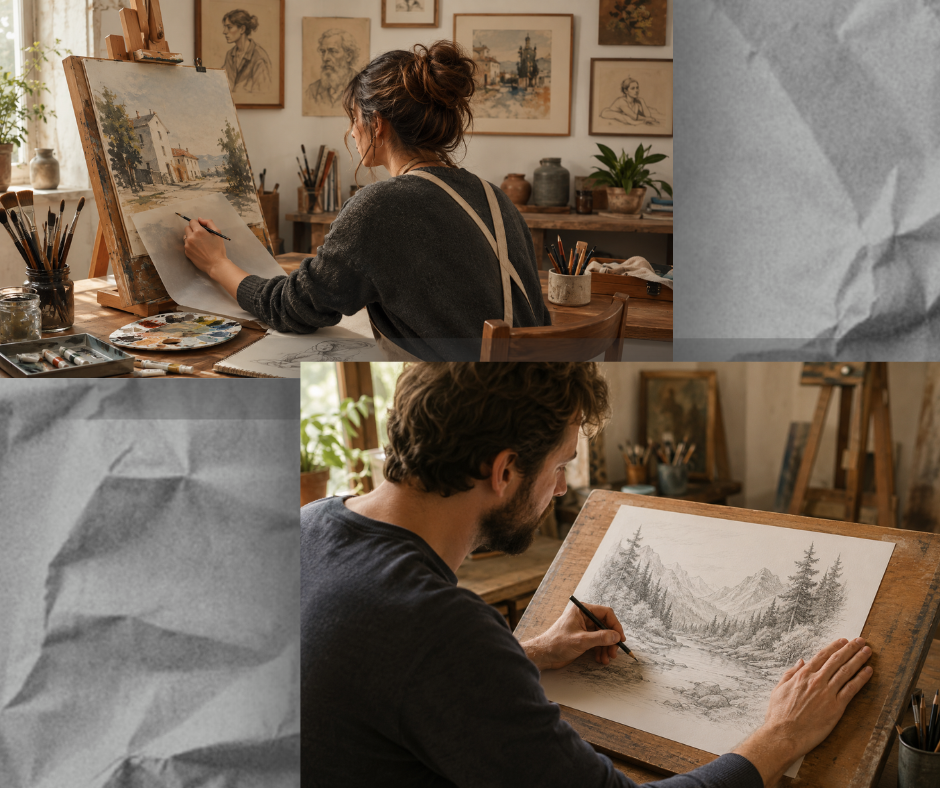
And lefties are in good company: some of the most celebrated artists in history created their work with their left hand.
*** The Challenges of Making Art Left-Handed ***
Many art tools and techniques are designed with right-handed users in mind, which can create challenges for left-handed artists. Smudging is especially common when working with pencil, charcoal, pastel, or ink, and some tools or demonstrations can feel awkward to use or follow. Simple adjustments, like working right to left, rotating the canvas, or placing a protective sheet under the hand, can make creating much easier.
*** Are There Advantages to Being Left-Handed? ***
There’s a popular idea that left-handed people are naturally more creative, but research hasn’t proven that handedness alone makes someone a better artist. Still, lefties may develop useful creative habits from constantly adapting to a right-handed world, such as approaching tools, brushstrokes, and layouts in different ways. Handedness can even leave clues in artwork, like the direction of repeated strokes has helped historians identify artists such as Leonardo da Vinci as left-handed.
*** Famous Left-Handed Artists ***
-- Leonardo da Vinci is probably history's most famous artistic left-hander. He was well known for writing notes in his distinctive right-to-left "mirror writing," and his drawings contain characteristic marks associated with his left hand. Interestingly, modern analysis suggests Leonardo may actually have been capable of writing and working with both hands.
-- M.C. Escher, famous for his impossible staircases, tessellations, and mind-bending perspectives, was also left-handed. As a child, Escher was reportedly pressured to work right-handed, a common practice at the time, but eventually became skilled with both hands. The museum dedicated to his work notes that this ambidexterity became useful in his artistic practice.
-- Paul Klee, whose imaginative paintings combined abstraction, symbols, geometry, and expressive color, is another celebrated artist identified as left-handed. His work ranged from carefully structured compositions to playful, almost childlike imagery, and he became one of the influential teachers associated with the Bauhaus.
-- Michelangelo is also commonly included among history's famous left-handed artists, along with artists such as Peter Paul Rubens and Hans Holbein the Younger. The Metropolitan Museum of Art has highlighted all of them among the notable left-handed artists represented in its collection.
Note: One important complication is that determining handedness hundreds of years later isn't always easy. Artists sometimes learned to use both hands, and even self-portraits can be misleading because painters often worked from mirrors.
So while lists of "famous lefties" can vary, there's no question that left-handed artists have played an important role throughout art history.
*** There's No "Right" Hand for Making Art ***
Ultimately, great art isn't determined by which hand holds the brush. Left-handed and right-handed artists may approach certain movements differently, but creativity comes from observation, experimentation, practice, and finding a process that works for you.
That's also one of the great things about painting at PINOT'S PALETTE... You don't need to worry about whether you hold your brush the same way as the instructor... or anyone else in the room. Our artists guide you through the painting step by step, but you're always encouraged to make it your own. Whether you're a proud lefty, a righty, or someone who somehow manages to paint with both, grab a brush, a drink, and some friends and come enjoy a creative night out.
There's no wrong way to make something you love!