

Do You Know The History Of These Everyday Items?
*** Here’s a look at the fascinating history behind some of the most everyday items we use all the time.
— The Toothbrush —
The modern toothbrush’s roots can be traced back to ancient China. During the Tang Dynasty (7th–10th century), people used bone or bamboo handles with bristles made of hog hair for their brushes.
And before that, civilizations in ancient Egypt and Mesopotamia used twigs frayed at the end, called “chew sticks”, to clean their teeth.
The real turning point for the design of the toothbrush came in 1938 when nylon bristles were introduced. These replaced animal hair, which was much-needed as the hair held bacteria and wore down quickly. From there, toothbrushes became more hygienic, more affordable, and eventually electric.
So, the next time you brush your teeth, you’re actually participating in a daily ritual that’s over a thousand years in the making!
\
— The Coffee mug —
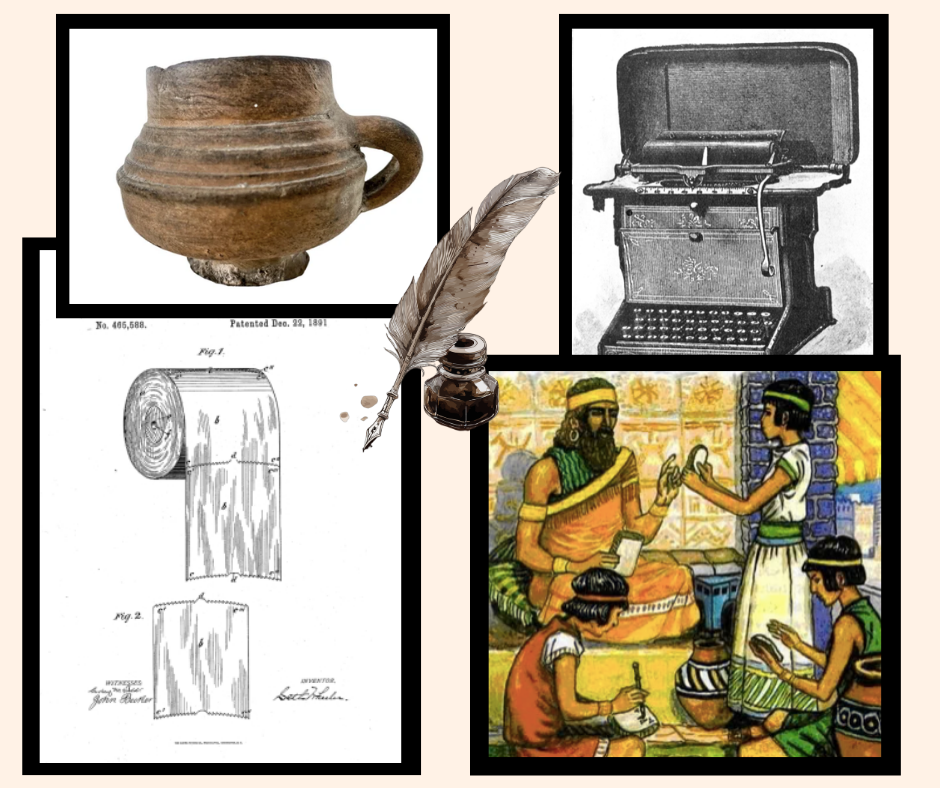
Did you know that drinking vessels date back to prehistoric times? Early humans would shape clay into simple cups for the first liquid-holders, but as civilizations developed, so did the drinkware!
**Examples Include:
(1) Medieval Europe favored sturdy tankards (large, roughly cylindrical, drinking cups with a single handle_
(2) China refined porcelain techniques, utilizing a blend of kaolin and petuntse fired at extreme temperatures.
(3) The 18th and 19th centuries saw the rise of mass-produced ceramic mugs.
The addition of the handle was a game-changer… especially for hot drinks. The basic coffee mug began to evolve alongside the rise of coffee culture itself; In this way, it became not just functional, but personal. Today, mugs serve as souvenirs, gifts, and little pieces of identity sitting on our desks.
— The Lightbulb —
The electric light bulb is often credited to Thomas Edison, BUT he wasn’t the only inventor working on it…
Dozens of scientists actually experimented with electric light throughout the 19th century.
Edison’s breakthrough in 1879 wasn’t inventing the concept, but creating a practical, long-lasting filament (*and a system for distributing electricity).
Today’s LED bulbs are far more energy-efficient and long-lasting than Edison could have ever imagined! Still… every time you flip a switch, you’re tapping into a 150-year-old revolution that changed how humans live, work, and create.
— Toilet paper —
Toilet paper, as we know it, didn’t become commercially available until the 19th century. Before that time, people would use everything from leaves and moss to corncobs and even old newspapers.
China was the first to manufacture paper specifically for hygiene (as early as the 6th century). But it wasn’t until 1857 that Joseph Gayetty introduced packaged toilet paper in the United States.
And the perforated roll? That innovation came in 1890 and made it dramatically easier (and less awkward) to use. Small design tweaks like perforation often shape habits more than we realize.
— The “QWERTY” Keyboard —
The “QWERTY" layout was designed in the 1870s for mechanical typewriters. Though many believe so, it actually wasn’t necessarily created to slow typists down; It was meant to prevent metal type bars from jamming.
The layout spaces commonly used letter pairings apart, making the machine more reliable. When typing moved from mechanical typewriters to computers, the layout stayed.
Even on glass screens and ultra-thin laptops, we’re still using a system designed for clunky metal machines nearly 150 years ago.
— Soap —
Soap dates back to ancient Babylon around 2800 BCE. We know about this because archaeologists found clay cylinders containing soap-like material made from fats boiled with ashes.
Did you know that for centuries, soap was primarily used for cleaning textiles rather than bodies?! It wasn’t actually until public health movements in the 19th century that regular bathing with soap became widespread.
Today, liquid soap dispensers and antibacterial formulas line every sink; Still, the chemistry behind them hasn’t changed much from ancient experiments with fat and ash.
And More:
*** The Zipper ***
(1893/1913)
Originally a bulky "clasp locker" for shoes, it was improved by Gideon Sundback into the modern zipper, which gained popularity after being used on military gear during WWII.
*** Ballpoint Pens ***
(1940s-50s)
Initially a luxury item costing over $12, it became a staple of everyday life thanks to Marcel Bich, who utilized new plastics and production techniques to make them cheap and accessible by 1950.
*** Heat Detectors ***
Different versions of smoke and heat detectors have been around since the late 1800s, but a key step in the invention's evolution came from Swiss physicist Walter Jaeger.
The story goes that Jaeger was trying to create a device that would detect poisonous gas. It didn’t work. One day, he lit up a cigarette and voila! His failed poison detector revealed itself to be an effective smoke detector. It would take decades for further technological advances to bring the devices into homes around the world, but they’ve saved thousands of lives since then.
*** The Pencil ***
The pencil might seem like the epitome of simplicity, BUT its invention was actually a game-changer. Before pencils, people used lead or ink for writing, but it was often messy and inconvenient. The pencil, as we know it, began in the 16th century when a huge deposit of pure graphite was discovered in England. Local shepherds used graphite to mark their sheep, and soon the material was wrapped in string or inserted into wooden sticks to make a more refined writing instrument.
The real breakthrough came in 1795 when a French scientist Nicolas-Jacques Conté developed a method to mix powdered graphite with clay and encase it in wood. This method allowed for pencils to be produced in various hardness levels; It revolutionized the way people wrote and drew, making the pencil an important tool for artists, writers, and students alike!
FUNFACT: For those of you who are artists or know any art-lovers, you’ve likely heard of "Conté sticks” (or "Conté crayons"), which are professional-grade, square-shaped drawing tools invented in 1795, composed of compressed natural pigments, graphite, and clay. These art materials are harder than pastels and charcoal and offer a waxy, versatile, and less-messy medium. They're perfect for sketching, fine lines with corners, or broad strokes with flat edges.